# The Art of Indian Miniature Craftsmanship: A Tradition Worth Preserving
What Is Indian Miniature Craftsmanship?
Indian miniature craftsmanship is the practice of recreating the large in the small — with precision, patience, and an understanding of what makes the original worth recreating at all.
It is one of the oldest artistic traditions in India. From the intricate miniature paintings of the Mughal and Rajput courts to the kumhar‘s miniature clay pots, to temple sculptors working at a scale that demanded magnification to be fully appreciated — the miniature has always occupied a special place in Indian aesthetic culture.
Today, miniature craft in India is experiencing a quiet revival: not as museum-piece preservation, but as living practice. Artisans trained in contemporary studios are applying the discipline of the miniature to subjects that matter to modern Indians — architectural landmarks, street food, sacred spaces, domestic memories.
This is the tradition that Esmaric works within.
The History of Miniature Craft in India
Court Miniatures: Mughal and Rajput Traditions
The most widely recognised Indian miniature tradition is miniature painting — the extraordinarily detailed illustrated manuscripts and portraits produced at the Mughal court from the 16th century onward, and the parallel tradition of Rajput miniature painting that developed across Rajasthan, the Punjab hills, and central India.
These were works of extraordinary precision: figures rendered at a scale of a few centimetres, with visible facial expressions, fine textile patterns, and detailed architectural backgrounds. Entire battle scenes were compressed into compositions small enough to hold in one hand.
The workshops (karkhanas) that produced these works operated on a master-apprentice model: a senior painter would establish the composition and the style; trained assistants would execute specific elements — faces, borders, backgrounds — under close supervision. Quality was maintained through teaching, not just individual talent.
Clay and Ceramic Miniatures
Parallel to the court painting tradition, India’s kumhar (potter) communities have produced miniature clay objects for centuries — small vessels, figurines, and ceremonial objects whose scale demanded exceptional hand control and an intimate knowledge of the material.
In many parts of India, miniature clay work was associated with festivals and rituals: miniature cookware for Gangaur, small clay animals for Pongal, tiny representations of deities for household shrines. These were not just decorative — they were functional within a ritual context, and their smallness was part of their significance.
Temple and Architectural Miniatures
India’s temple architectural tradition also produced miniatures: rathas (miniature chariots), vimanas (model towers), and small-scale representations of significant shrines that could be placed in domestic worship spaces. These were understood as concentrated versions of the sacred — able to carry the presence of a larger space in a smaller form.
What Makes a Miniature Genuinely Difficult
The challenge of miniature craft is not simply that things are smaller. It is that every proportion matters more at small scale.
In a full-sized building, a wall that is 2 cm too thick is invisible. In a 52 cm architectural miniature, the same discrepancy is immediately apparent. Every element — the depth of a carved detail, the angle of a pillar, the relationship between floor area and height — must be studied and deliberate.
This is why serious miniature craft requires extensive research before a single piece is made. The craftsperson must understand not just how something looks, but why it was designed the way it was, what governed the proportions, and how to render that understanding at one-tenth the scale.
At Esmaric, each new design begins with this research phase — studying the architectural or cultural subject in depth, understanding its governing logic, and then determining how to express that logic in a form that can be held, displayed, and appreciated at human scale.
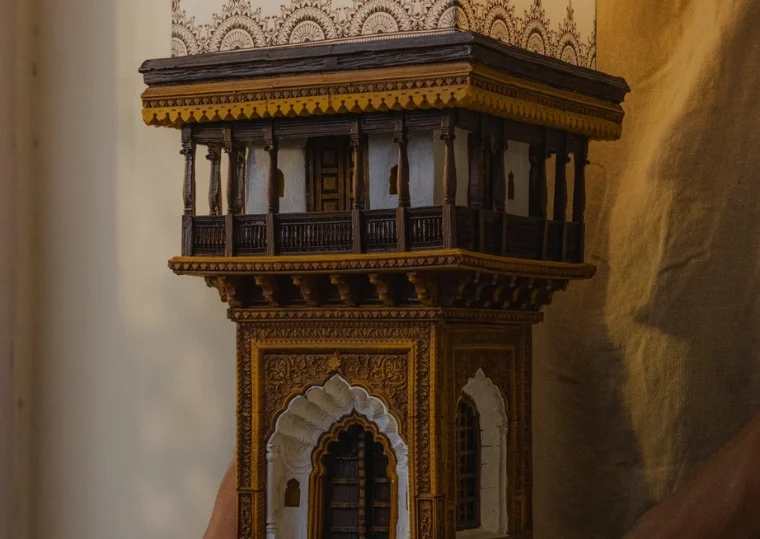
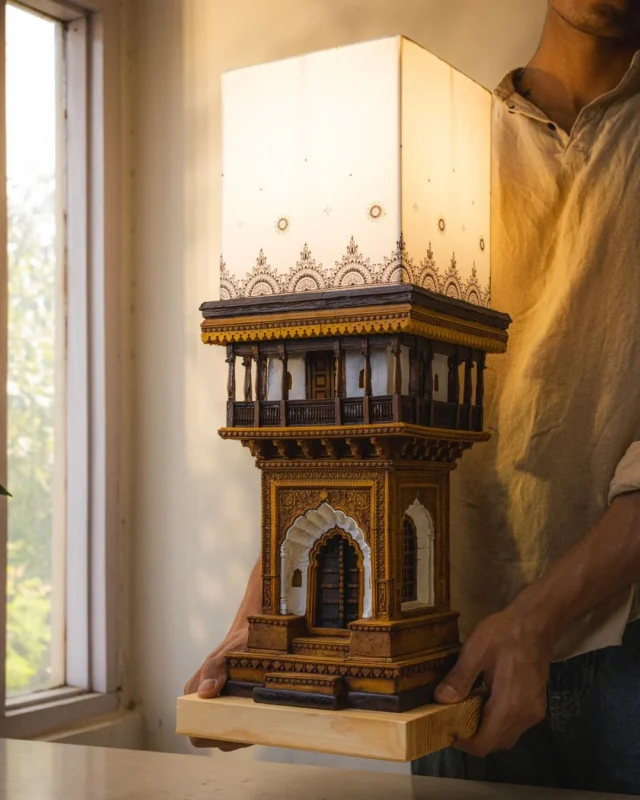
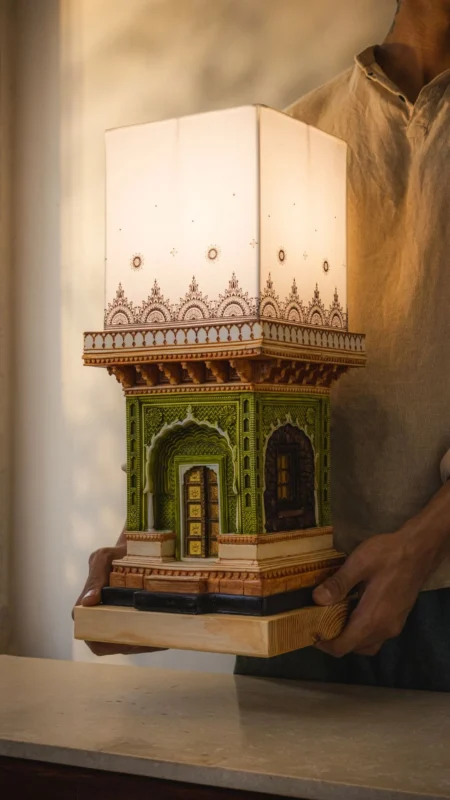
The Aangan Miniature Lamp, for example, required months of study of traditional Indian courtyard architecture before the design was finalised. The four-pillar structure, the proportional relationship between courtyard floor and pillar height, the way light moves through the structure at different times — all of these were considered before any physical prototype was made.
The Artisan Training Model: How Quality Is Transmitted
One of the oldest questions in craft is: how do you maintain quality as you scale?
In industrial production, the answer is mechanisation — remove the human variable, and quality becomes consistent. But in craft, this answer destroys the thing being preserved. A handcrafted object that has been mechanised is no longer handcrafted in any meaningful sense.
The traditional answer, in Indian craft as in craft traditions worldwide, is the master-apprentice model: a skilled creator trains others to see what they see, to care about what they care about, and to execute at the level they execute.
This is how Mughal miniature painting workshops operated. It is how temple sculpture schools worked. It is how kumhar communities transmitted their knowledge across generations.
Esmaric practises this model today. Once a design is finalised — after the research, the prototyping, the iteration — Esmaric trains a team of artisans to execute it. Each artisan learns the specific language of that design: the textures, the tolerances, the finishing standards, the details that distinguish an acceptable piece from an excellent one.
The result is that every Esmaric piece, regardless of when it was made or by which hands, meets the standard of the original. The quality is not in the individual — it is in the system of transmission.
Why Indian Miniature Craft Matters Now
India is in the middle of a significant cultural moment. After decades in which Western design aesthetics dominated aspirational home decor, there is a growing, genuine appetite among urban Indians for objects that reflect their own culture — not as kitsch or nostalgic decoration, but as serious design.
This appetite is driven by several forces:
The rise of the design-aware Indian consumer. A generation of Indians who grew up with international design exposure is now asking what Indian design can offer at the same level of sophistication. The answer, increasingly, is: a great deal.
The rediscovery of heritage. India’s architectural and cultural heritage — its haveli architecture, its courtyard houses, its temple traditions, its festival objects — is being rediscovered not just by tourists but by Indians themselves, many of whom grew up without access to these traditions.
The limits of mass production. As design literacy grows, so does awareness of the difference between something genuinely made and something merely assembled. Handcrafted objects — with their visible evidence of human attention — occupy a different category from their factory-produced equivalents.
Indian miniature craft sits at the intersection of all three of these forces. It is sophisticated design, drawing on deep heritage, made by human hands.
How to Identify Genuine Quality in Indian Miniature Craft
Not all miniatures are created equal. Here is what to look for in a genuinely well-made piece:
Proportional accuracy. The miniature should look like it was designed, not assembled. Proportions that are slightly wrong — pillars too thick, arches not quite arched enough — are immediately visible and indicate a design that was not studied carefully.
Finish quality. Look at the surface. Is it consistent? Are edges clean? Is the texture intentional or accidental? In a well-made miniature, every surface decision was made deliberately.
Structural integrity. A quality miniature is built, not stuck together. It should feel solid, not fragile in a way that suggests it will not last.
A demonstrable research process. The best makers can tell you what they studied, what decisions they made, and why. If a craftsperson cannot explain what went into a piece, the piece probably did not have much go into it.
Provenance. Where was it made? By whom? Under what conditions? These are not pretentious questions — they are the questions that distinguish craft from mass production.
Esmaric and the Future of Indian Miniature Craft
Esmaric’s work sits within this larger tradition and looks forward from it.
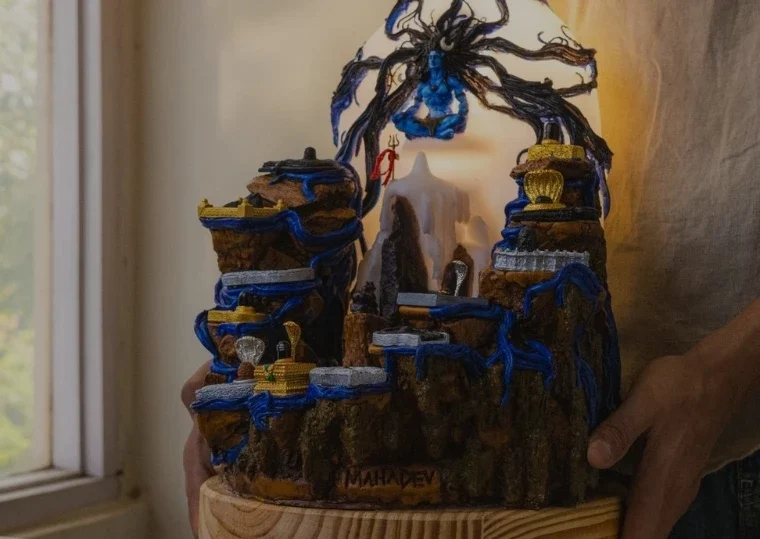
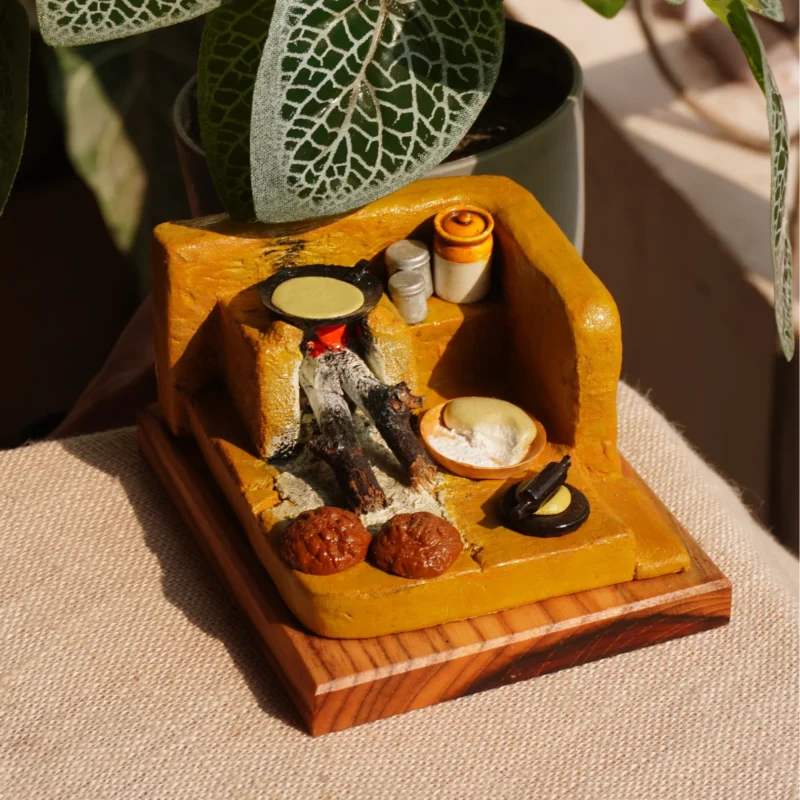
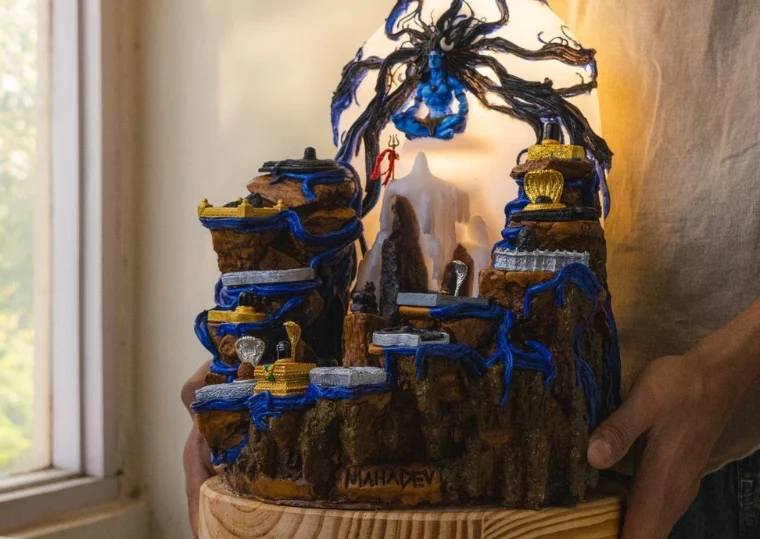
The subjects — the aangan, the street food stall, the Jyotirlinga, the nostalgia corner — are drawn from Indian life as it is actually lived and remembered. The design process is rigorous and research-led. The production model honours the master-apprentice tradition that has sustained Indian craft for centuries.
Explore the Aangan Lamp by Esmaric →
The result is objects that function as both decor and cultural artifact — pieces that can be explained, that carry a story, and that hold their meaning over time.
This is what Indian miniature craft looks like when it is taken seriously.
Frequently Asked Questions
What is Indian miniature craft?
Indian miniature craft is the tradition of creating detailed, small-scale objects — paintings, sculptures, architectural models, and decorative pieces — with precision and cultural depth. The tradition spans Mughal and Rajput court painting, clay and ceramic work, and temple architectural miniatures, and continues today in contemporary studios like Esmaric.
What makes Indian miniature painting different from other miniature traditions?
Indian miniature painting, particularly the Mughal and Rajput traditions, is distinguished by its extraordinary precision, its use of natural pigments, and its narrative depth. Compositions that depict entire royal courts or battle scenes at a scale of a few centimetres represent one of the world’s most demanding craft traditions.
How are Indian miniature craft objects made today?
At Esmaric, the process begins with extensive research into the architectural or cultural subject, followed by prototyping and design iteration. Once a design is finalised, trained artisans learn to execute it to the established standard — a contemporary application of the traditional master-apprentice model.
Why is Indian miniature craft significant?
It preserves design knowledge and cultural memory that would otherwise be lost. A well-made miniature of a traditional Indian courtyard, for example, encodes architectural knowledge — proportions, structural logic, spatial experience — in a form that can be held, displayed, and transmitted across generations.
Where can I buy authentic Indian miniature craft objects?
Esmaric (esmaric.in) produces handcrafted miniatures celebrating Indian culture, including architectural lamps, food and street culture miniatures, spiritual collectibles, and heritage pieces. All pieces are made in South Delhi by artisans trained on specific designs.
What is the difference between a collectible miniature and a decorative miniature?
A collectible miniature is made with sufficient precision, cultural depth, and provenance that it holds meaning and value over time. A decorative miniature may be visually appealing but is typically mass-produced and lacks the research, craft, and story that make a piece worth collecting. Esmaric’s pieces are designed to function as both.
Esmaric — Essence of Bharat. Handcrafted miniatures from South Delhi, celebrating the stories, spaces, and craftsmanship of Indian culture.
Shop the full collection at esmaric.in